

UP #11 Alistair Sung

Sounds from a world yet to come
As a teenager, Alistair Sung walked through the scorching Australian sun to his first cello lessons, carrying an instrument that was almost bigger than himself. Years later, he is still on the move with that same instrument. Not searching for a final answer, but for sounds and compositions that have not existed yet on the other side of the world.
Cellist Alistair Sung lives in Amsterdam and has worked across the worlds of indie, electronic and experimental music, collaborating with artists like Justin Vernon (Bon Iver), Matmos and Nik Colk Void. For him, the cello is not a fixed instrument, but a space where worlds can overlap and collide. Together with Cello Octet Amsterdam, he brings COCON to Korzo: a performance in which eight cellists translate electronic compositions into a new acoustic language while sharing the stage with eight moving robotic arms. What drives Alistair’s constant search for new forms and sounds?
"Maybe I’m a bit of a shape shifter."
Your classically trained, yet open-minded. Where does that openness come from?
“I’m half Malaysian-Chinese, half Australian, and throughout my life I’ve found myself not fitting in, but also fitting in. Maybe I’m a bit of a shape shifter. I’ve done that whole hardcore classical thing, but also more experimental and pop performances. I think I just don’t want to feel constrained and want freedom to be part of what I do and who I am.”
“I didn’t feel like I belonged
to the roots of what a conventional
classical cellist is.”
Who helped you find the freedom to become that kind of musician?
“My cello teacher Marcus Hartstein was someone who would not spoon-feed me the answer but would encourage me to think broadly. I was a bit of a dreamer, and he was stricter, but he respected the fact that I wasn’t going to take the classical route. Although he himself has an intense passion for Western classical music, he allowed me that freedom. And he became family; he came to visit me the other month!”
That search for freedom is what brings Alistair to new musical utopias. For him the cello is not something fixed, but an instrument full of unexplored possibilities.
“I’m interested in using acoustic
cello sounds as the foundation
of my electronic music.”
You’re exploring the space between acoustic instruments and electronics. What interests you in bringing these two together?
“It’s again related to this idea of two worlds overlapping and colliding with each other. Combining those worlds somehow makes sense. While studying classical cello, I read interviews with more mainstream artists who were inspired by 20th-century avant-garde composers like Stockhausen and Ligeti. While Western harmony was the driving force in much of the history of Western classical music, 20th-century composers sought to develop a more equal approach to all musical elements. With the advent of electronic music, the focus shifted to exploring sound in a compositional way. This approach was then taken up and developed by so many incredible electronic artists who followed. I’m interested in using cello sounds as the foundation of my electronic music and emulating certain electronic sounds acoustically.”
When you experiment, you enter a world that doesn’t exist yet. What makes you willing to step into that unknown?
“There’s an aspect of curiosity and trust. There’s such a high standard in the Cello Octet, that I always trust that it’s going to be good. We’re always pushing each other. And again, with COCON we’re taking music that, to some of us, is completely foreign. When you’re entering a project where you don’t know what the outcome is going to be, we know at least it’s going to be executed to the best of our abilities.”
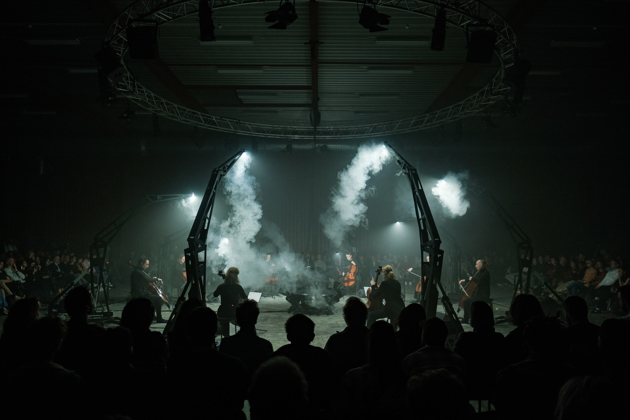
What does arranging music for eight adventurous cellists actually look like?
“For COCON I arranged Scratches on the Readable Surface by the Italian composer and sound artist Catharina Barbieri. I spent hours behind my laptop, listening to the original and trying to capture its atmospheres. Catharina helped me understand the conceptual side: spiderwebs and fractal rhythms. The piece has a repeating melody with different delays bouncing around, creating a constantly shifting rhythm. I translated that to the cello, then brought a draft version to the other seven (seriously good) octet players. With them it’s very much a collaboration; I just wrote the skeleton.”
COCON is a collaboration in more ways than one. How did the robotic arms become part of the performance, and how do you interact with them on stage?
“Sanne Bijker initiated this project and came across the work of artist Nick Verstand, whose work, like Cello Octet’s, combines the mechanical with the organic. Together they developed the idea of the cocoon, and we rehearsed it collectively, but during the performance he’s essentially improvising. Most of the music isn’t played to a click track, and we often shape the dynamics in the moment, as classically trained musicians do. We even adapt the music to each room, since every space has a different reverb. So, in a way, with COCON all of us are constantly adjusting to our surroundings.”
I always ask people what gives them hope in times of despair.
"Funnily enough: a lot of the octetters have children, and they sometimes come along to performances. Seeing these kids gives me hope, they’re such good people and intelligent and curious. I’m going to have a baby in November!"
What do you hope people take home after COCON?
“Maybe some kind of reflection on how we relate to the natural world. Are we part of it or separate? The idea of the cocoon is associated with protection but also a place for development. Like the caterpillar develops into a butterfly. A place where things are shifting and growing.”
So, are you then a caterpillar or a butterfly?
[laughing both] “I think I’m permanently living in the cocoon.”
COCON comes to Korzo from Thursday 17 to Saturday 19 September.
Get your tickets while you can!
The illustration on Alistair’s portrait was created by The Hague-based visual designer Carmen Draxler. She introduces shapes inspired by mitochondria, the cells’ powerhouses, as a visual link between the electronic and the organic. The eight-pointed form in the background echoes the eight cellists of the Cello Octet.
Bekijk ook

UP#12 Andreas Hannes
"I'm doing what I miss in the dance world."Skipping. Who would have thought such a simple movement could be connected to so many aspects of life? Choreographer Andreas Hannes spent ten years...
Verder lezen
Korzo start Protestkoor
Ben jij een (potentiële) zangvogel en kan je niet langer stilblijven?Korzo start Het Haagse Protestkoor: een nieuw koor voor Haagse zangvogels die iets te zeggen hebben. Onder leiding van...
Verder lezen